International tension: prepare without alarm
What European authorities actually recommend if the world gets complicated. No alarmism, no bunker: the same things you already need for a blackout, applied to a longer scenario.
This document does not say a war is coming to your country. It says something more useful: if the world ever gets complicated, the first help will not reach your home in the first hour. And that is already true today with a storm, a flood or a long blackout.
Why this is being talked about now
Since 2022, and above all since the EU Preparedness Union Strategy (March 2025), European governments have started saying out loud something civil protection agencies have quietly recommended for decades: households should be able to be self-sufficient for at least 72 hours.
The European Commissioner for crisis management put it in a phrase repeated across the press: “We are saying to member states: 72 hours of self-sufficiency is what we recommend.” It is not a war prediction. It is the same 72-hour rule that applies to an earthquake, a flood or a snowstorm.
Germany announced a package of around €10 billion in 2026 to strengthen its civil defence; Sweden sends every household the booklet If crisis or war comes; Finland has maintained the public concept 72 tuntia (72 hours) for years. Same message everywhere: prepare at home, not in a bunker.
The important part first: it is what you already need to do
If you have already put together the 72-hour kit, the family plan and the documents folder, you are already ahead of 90% of your neighbours. In a scenario of international tension those three things are still the core, with four adjustments.
- Water and food for more days: if the scenario is long, move from 72 hours to one or two weeks at home (not in the backpack). The real bottleneck is not food: it is water.
- Cash: if card terminals or the network go down, you cannot pay by card. Keep small notes.
- Documents and copies: originals on you, copies in the cloud and on paper. In a forced displacement, without papers you are nobody.
- A family meeting point: two, in fact. One near home and one outside your city, in case you get separated and there is no coverage.
Alerts: how you will be warned
In Europe there are three official channels. Recognising them in advance avoids panic and, above all, stops you believing a WhatsApp rumour.
- Siren or emergency message: Spain and most EU countries have a mass mobile alert system. A loud beep and a message on screen, with nothing to install. If it sounds, read it and act. Do not reply and do not forward it.
- Radio: FM/AM radio and a battery radio remain the most robust channel when the internet and mobile networks go down. Keep a battery or hand-crank radio with spare batteries. This is the literal advice of the Swedish agency MSB.
- Official channels: the official account of your country's and your municipality's civil protection. In Spain, 112 and the warnings from AEMET and Protección Civil.
Shelter: what it is and what it is not
This is the most misunderstood part. You are not looking for a bunker: you are looking for the best place in your home or neighbourhood to spend a few hours protected. The Swedish agency says it plainly: in the event of an alarm, go to a civil defence shelter or any protective space: a cellar, a garage, an inner corridor, a ground floor without windows.
- Cellar or inner ground floor, with no windows or as few as possible. The less glass, the better.
- Away from windows and outer facades: the main risk is glass and debris, not the “blast wave” from the movies.
- Concrete or stone structures before lightweight, wooden or prefabricated ones.
- If you are in a car: do not leave it in the middle of the road. Park next to a building and go inside. This is the official instruction of the Estonian alert system and most neighbouring countries.
- At home, choose your spot now: today, unhurried. If tomorrow you have to decide it in 30 seconds in the dark, you will choose badly.
What you should not do: go out into the street to see what is happening, drive to find relatives in the middle of an alert, take the car with no destination, or phone everyone. Networks saturate and emergency calls cannot get through. A short SMS or text message often gets through where a call will not.
Iodine and nuclear incidents: do not take it on your own
This is where most misinformation circulates. The official position of the CDC and the WHO is blunt and worth memorising: iodine (potassium iodide, KI) is only taken if the authorities explicitly say so. Not before, not “just in case”, not because you saw it online.
- It only protects the thyroid against radioactive iodine, and only in a specific nuclear incident.
- It does not protect against other radiation, and it does not replace moving away or sheltering, which is the measure that really matters.
- The useful window is narrow: from less than 24 h before to 2 h after the expected exposure. Taking it days in advance does not work; taking it without instruction can cause harm, especially to the thyroid and to people with pre-existing conditions.
- If your area is at risk, your health authority provides the information on iodine tablets: where they are distributed, to whom and in what dose. Ask now, not in the middle of the warning.
- Watch out for internet dosages: amounts vary by age and country, and pregnant women and children have their own guidance. Do not improvise from what you read.
What changes compared with the normal kit
- Water: go up to 1-2 weeks at home (3 L per person per day)
- Non-perishable food for 1-2 weeks, plus a gas stove with a spare canister
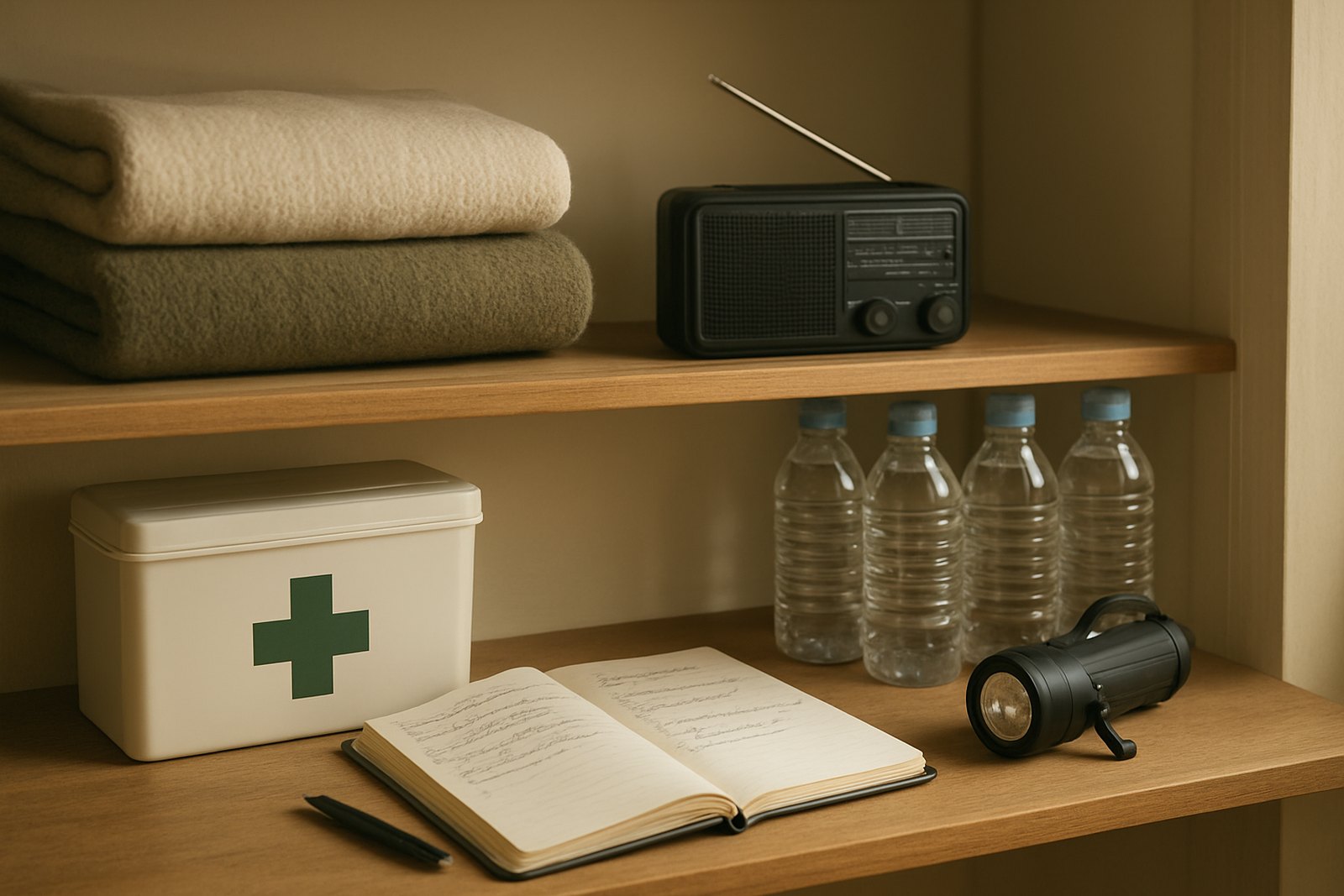
- Battery or hand-crank radio, with spare batteries kept separately
- Cash in small notes
- Full first-aid kit and chronic medication for one month
- Torch and candles (carefully), plus a head torch
- Phone charger with power bank, always charged
- Document copies on paper and in the cloud
- Water containers for household use (not just drinking bottles)
- Wash bag and warm clothing in a single bag per person
- Phone list ON PAPER (without a phone there is no contact list)
- Family agreement: a meeting point nearby and a meeting point outside the city
The 10 minutes best invested today
You do not need to spend money or buy anything strange. These five things are free and worth more than any purchase:
- Choose your protective space at home and at work, and tell your family which one it is.
- Agree the meeting point (one nearby, one outside the city) and who notifies whom.
- Write down on paper the important phone numbers and the emergency number. A piece of paper in your wallet survives a dead phone.
- Check which official channel your municipality uses (app, social media, siren) and turn on its alerts.
- Go over the plan: do you know where iodine tablets are if your area distributes them? Do you know which local radio broadcasts in your area?
The message, in one sentence
Official sources
- European Commission — EU Preparedness Union Strategy (2025): 72-hour self-sufficiency recommendation. commission.europa.eu/topics/preparedness_en
- MSB (Swedish Civil Contingencies Agency) — “If crisis or war comes” booklet, sent to every Swedish household. mcf.se
- 72tuntia.fi — official Finnish home preparedness concept (72 hours). pelastustoimi.fi
- CDC (US) — Potassium iodide in radiation emergencies: do not take unless officially instructed. cdc.gov
- WHO — Use of potassium iodide for thyroid protection: administration window. who.int
- 112 — single emergency number across the European Union.